Exploratory writing
The rough draft is how we find the essay.
Students often expect a first draft to look like a nearly finished application essay. This exercise makes room for discovery. It begins with an idea that interests the student and ends with more material, better questions, and a clearer sense of what may be possible.
I sometimes compare this step to a study or research project. After collecting possible material, choose one promising thread and examine it closely. Write down what happened, what you noticed, and what questions come up. The draft gives you more to work with as you decide where to go next.
That is why drafting can be brainstorming. A list of memories may give you a starting point, but writing can uncover details and connections that were hard to reach by thinking about the idea in the abstract. The practice draft is exploratory work; the student can follow it, change direction, or save the material for later.
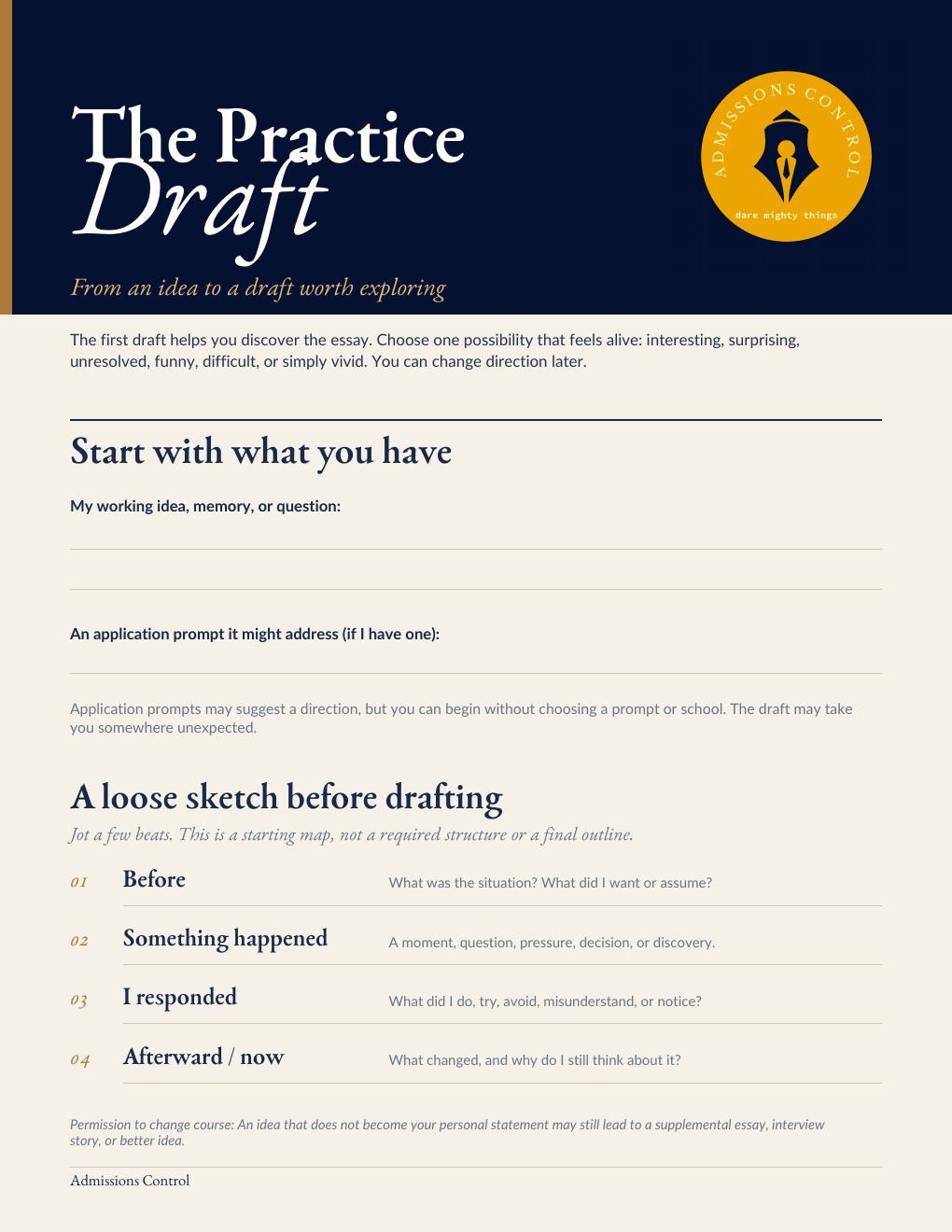
- Choose a working direction. Start with a memory, conflict, question, choice, or experience from the Story Bank. Pick one that feels alive, even if you are not sure why. You can glance at application prompts, but you do not have to commit to one before writing. Sketch a few beats, then treat the sketch as permission to begin; you may leave it behind once the writing starts.
- Freewrite the practice draft. Set aside one or two hours if possible, with at least 45–60 uninterrupted minutes at the beginning. Use a document, notebook, or voice dictation. Keep moving through the experience rather than stopping to polish sentences: where it began, who was there, what you wanted, what made it difficult or surprising, what you tried or misunderstood, and what happened afterward.
- Preserve the original and step away. Save an untouched copy of the draft. Take a day or two away from it before returning so you can reread with more perspective.
- Make a generative edit in a new copy. Keep the original unchanged. In a second copy, read with curiosity and ask “What else?” Add scenes, conversations, gestures, and details you left out. Explore what you believed then and believe now. Follow another memory or question the scene brings up. For this pass, expand before cutting.
- Look at what you discovered. Notice which scenes, questions, and connections have energy. What changes in the story or in your thinking? What might a reader still wonder? You can develop this draft, try another angle, save material for supplements, or return to the Story Bank.
The student chooses the story. No application requires disclosure of painful or private material. The goal is to learn what the student has, not to force every experience into an essay.
Do not worry yet about a word limit, a compelling hook, a finished structure, or beautiful sentences. Keep the awkward details and unexpected digressions; they may lead you toward the important part.