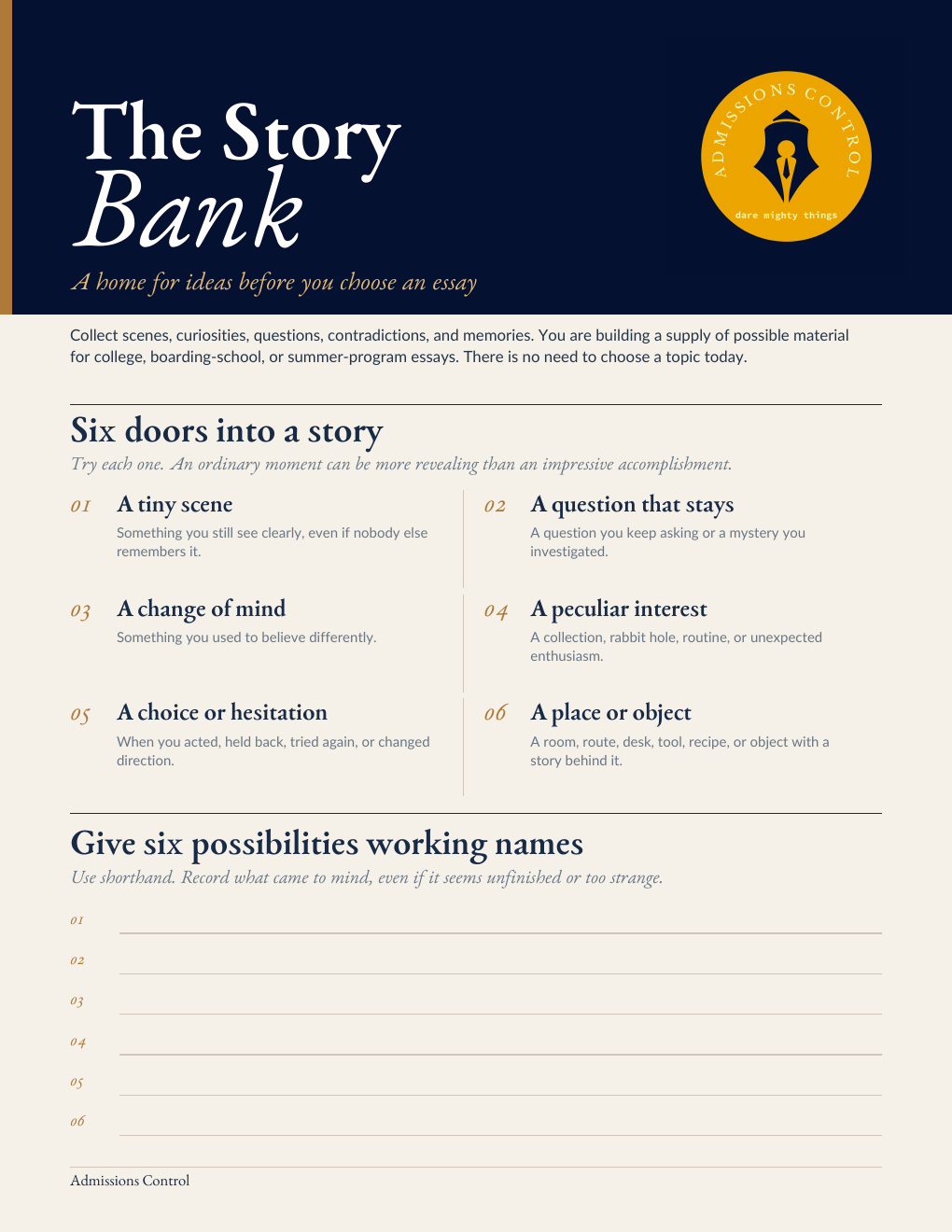
The method
Generate first. Choose later.
Students often try to pick the “right” topic before they have enough material to choose from. I sometimes compare this stage to a study or research project: you gather observations, details, questions, and examples so you have something to examine before deciding where to go.
The Story Bank is an ongoing collection students can return to when a new college, boarding-school, summer-program, or other application essay asks for something different. Record several possibilities and keep the details, questions, and connections that come with them. A story you do not use for one essay may help with another prompt or an interview later.
- Start from more than one doorway. Try a small scene, a persistent question, a changed opinion, a peculiar interest, a decision, or a place or object. Give each possibility a working name; you do not need to decide what it means yet.
- Get specific. “I love biology” names a topic. What experiment failed? What did you see? What question followed you home? Look for an event, detail, exchange, or unexpected thought another person could picture.
- Notice connections. Put two apparently unrelated experiences side by side. Ask what question, habit, contradiction, or way of thinking they share. Keep the ideas that resist a neat explanation, too.
- Keep the bank open. Save possibilities you do not use. An idea may become useful in a supplement, activity response, or interview when a new prompt arrives.
Brainstorming can continue in a draft
A list of ideas is one way to gather information. Writing a loose, exploratory draft is another. Follow one possibility closely and notice what turns up: the details, questions, choices, and connections that were hard to see from a distance. That draft is raw material for deciding what to explore next, not a promise to use the story or a request to polish it.
When an idea seems worth following, the Practice Draft exercise gives students room to write expansively, step away, and return with a “What else?” edit. They can add what they remember noticing, doing, or saying; what they believed then and believe now; and what other memory or question the scene brings up.
The student chooses the story. No one owes an application a painful or private experience. A small, specific moment can reveal thought, humor, curiosity, care, or change.